How Do You Plan for Large Format Canvas Prints in a Business Facility?
A photograph can be exactly right for your business and still be a difficult fit for the wall. Making it large enough for the wall may mean cropping out the detail that caught your eye. Keep its original proportions, and it may feel too small. When you’re choosing artwork for a whole workplace, those decisions multiply. Each one needs to be settled before the prints go into production.
Once you’ve chosen your artwork, the next step is pulling together the details for each room. The tips below will help you create a print list we can use to prepare your quote and produce your order.
Organize Your Print List by Room
Create a list of your prints by where they’ll hang, and label each image so it matches its file. One order might include artwork for the lobby, meeting rooms, and hallways, with different images and sizes for each space. Organizing the list by room helps you catch missing dimensions or unintended duplicates.
Some projects may use the same photograph or artwork in several places. If every copy has the same dimensions and finish, group them on one line and give the total quantity, with a note about where the copies go. If one copy needs a different size or finish, give it its own line. For each print, list the finished canvas dimensions as width by height.
A Real-World Example: 30 Canvas Prints for AG Credit Bank
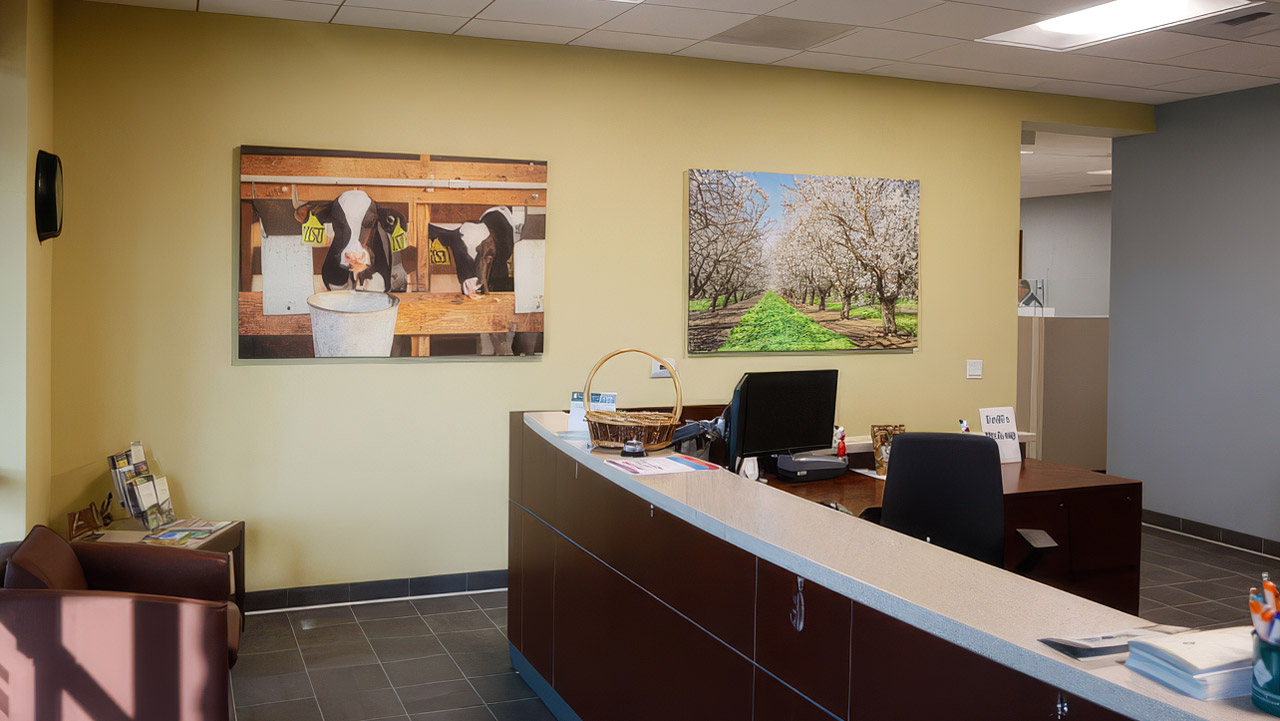
The AG Credit Bank project in Merced, California, is one example of the commercial projects we can help bring to life. Photographers Bill and Brigitte Clough of Captivating Photos LLC chose photographs and sizes for individual rooms, and we reproduced their work as 30 gallery-wrapped canvas prints, assembled and ready to hang. The project shows how a print list with different images and sizes can become a coordinated order for an entire facility.
(Below) Photography printed by Canvas Giclee Printing. Location: AG Credit Bank, Merced, California. Click image to enlarge.


Check Image Proportions and Gallery Wraps
The two ends of the size range in the Merced bank project illustrate a choice buyers often face. A 24 × 36-inch canvas has a 2-to-3 aspect ratio, while a 40 × 80-inch canvas has a 1-to-2 ratio. You can enlarge the first image without changing its proportions, but fitting it to the second size may require cropping or choosing a different image.
This is important when you’re choosing a print for a specific wall. If there’s a person, a building edge, or an important detail near the edge of the photograph, flag it when you provide the list. With a gallery wrap, the canvas extends around the stretcher bars. Let us know if you’re concerned about the edges, and we can discuss which parts of the image will appear on the front and sides.
Share the source file you plan to use, along with the intended print size, so we can review them together. If you have a size in mind and some flexibility, say so. That gives us room to suggest a size that works with the image and preserves a detail you want to keep. For color-sensitive work, ask what proof or sample options are available and when you’d need to approve one.
Consider a Single Print or Multiple Panels
For a large wall, one oversized print is one option. We produce large canvas prints in finished sizes up to 54 × 120 inches, depending on the quality and resolution of the image file. Share your intended dimensions with us so we can review whether the file is suitable at that size.
You can also divide an image across two canvas prints, called a diptych, or three, called a triptych. A multi-panel arrangement can cover a wider area or help an image work across a long wall. When preparing your list, note the overall space, the size and order of each panel, and the gaps you want between them. We can discuss how the image and gallery wraps will meet at the edges of each panel.
(Below) An example of a large canvas giclee print, presenting the front and back of the finished product. Click on image to enlarge.


Plan Your Giclee Printing Project Around Your Installation Date
The date your installer is booked and the date the prints need to reach the site are often different. Give us both. If the receiving team needs time to check the quantities, sort pieces by room, or move boxes to another floor, build that time into the arrival date you request.
Include the delivery address and let us know if the receiving site requires a delivery appointment or has other restrictions. If some prints need to go to a second location or arrive in a separate shipment, include that in the request so we can discuss delivery options while we prepare your quote. Ask how pieces will be identified on the boxes if your receiving team needs to sort them by room.
When you review the quote, check that it uses your latest print list and covers the right destinations. If you’re still deciding between two sizes or finishes, ask us to price both options for the affected pieces. Say which choices are firm and which ones could change. That gives your team a clear record of what the estimate covers when it’s time to greenlight the print job.
What to Include in a Canvas Giclee Printing Quote Request
A spreadsheet or a short list in an email can give us enough detail to start the conversation. Include:
- Print list by room or area. Give each piece an artwork name or file ID and enter the quantity for each version.
- Finished size and orientation. List width by height and flag dimensions that refer to the outside of each piece.
- Wrap and hardware. Share the choices you’ve made and flag any finish or mounting requirements you want us to review.
- Delivery address and dates. Include the required arrival date and the installation date. Note separate destinations or receiving restrictions.
- Decisions still open. Flag any questions about image quality, cropping, proofing, or packing so we can address them in the quote.
Sample order line
Conference Room A | Harbor-01.tif | 2 prints | 36 × 24 in. | gallery wrap.
Let's Discuss Your Large Canvas Giclee Print Project
If you’re planning canvas prints for several rooms, request a quote and tell us what you know about the project so far. Start with your print list and the dates you’re working toward. Flag the choices you’re still making so we can discuss them with you as we review the project.